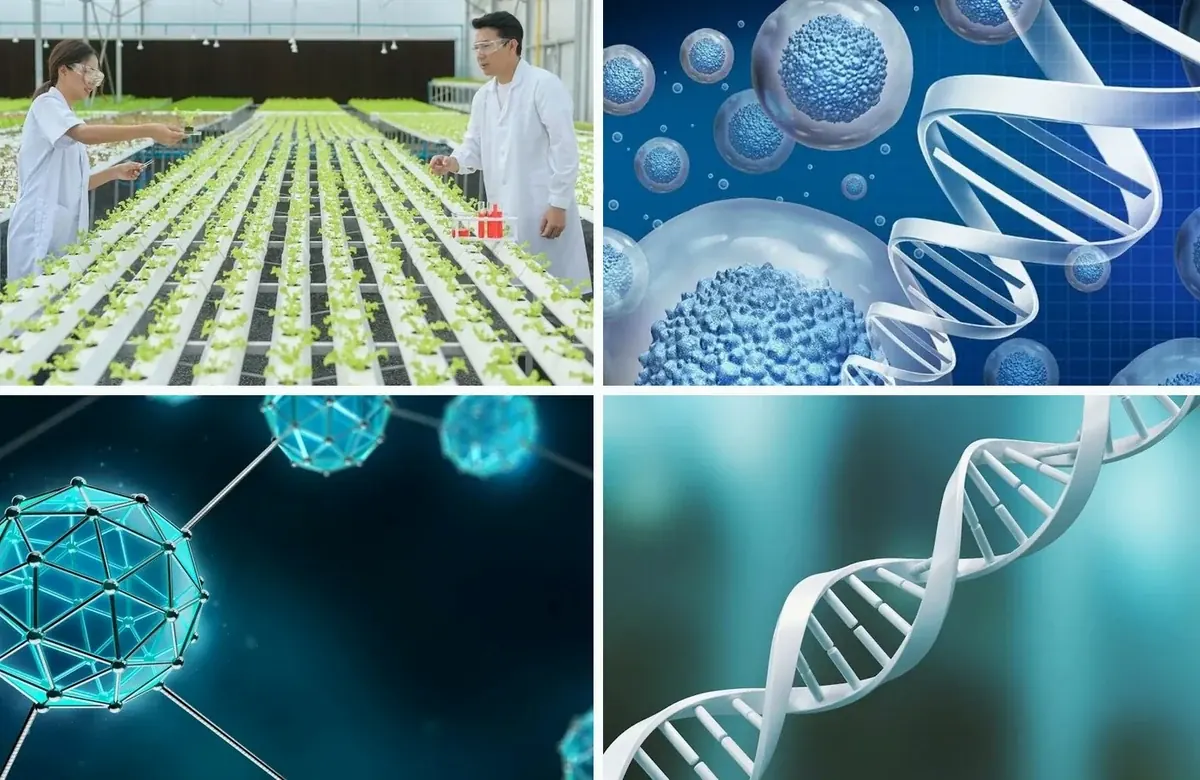
Sequence Foundations
Understand sequence formats, quality checks, identifiers and the biological meaning of retrieved records.
Explore project, internship and training pathways covering biological databases, sequence analysis, computational interpretation and integration with molecular research questions.

This interdisciplinary domain links molecular biology with computational tools used to retrieve, compare, interpret and document biological information. The final pathway is matched to the learner’s course, objective, duration and available data.
Understand sequence formats, quality checks, identifiers and the biological meaning of retrieved records.
Use suitable nucleotide, protein and literature databases for structured academic searches.
Compare sequences, organise outputs and interpret patterns relevant to the selected question.
Connect computational findings with molecular objectives, methods and academic reporting.

The pathway suits learners who need computational analysis, sequence-based interpretation or integration between biological data and laboratory-oriented research.
UG, PG and final-year learners developing sequence-analysis and database skills.
Learners integrating computational analysis with biotechnology projects and research themes.
Students connecting gene, transcript or protein questions with database-supported analysis.
Learners exploring microbial identification, comparative genomics or sequence-supported studies.
Students linking protein, enzyme or biomolecule questions with computational resources.
Feasibility-based support for scholars, faculty-guided work and institutional batches.
Topics are shortlisted after reviewing the learner’s background, available dataset, academic output and the level of computational interpretation required.
Identify suitable nucleotide or protein records and organise accession information.
Check completeness, formatting, orientation and basic suitability before analysis.
Compare selected sequences and interpret conserved or variable regions.
Review gene, protein, organism and functional annotations from reliable databases.
Use computational tools to support target-region and primer-related academic preparation.
Explore evolutionary relationships using suitable alignment and tree-building workflows.
Review protein sequence properties, domains or basic structure-oriented resources.
Organise computational outputs into figures, tables and academically relevant discussion.

These are broad academic directions rather than guaranteed ready-made titles. Dataset suitability and analytical scope are reviewed before confirmation.
The confirmed toolset depends on the biological question, dataset quality, learner level, available software and expected academic output.
Retrieve relevant sequences, records and literature using structured search logic.
Clean, format and organise selected biological sequences before analysis.
Perform suitable pairwise or multiple alignments and review the output.
Understand target selection and primer-related computational checks where relevant.
Create and interpret basic trees, plots or comparative summaries.
Record tools, parameters, outputs, limitations and interpretation clearly.


Bioinformatics pathways start with a biological question and traceable dataset, then select suitable databases, tools, parameters, validation and documentation.
Build a reproducible workflow for retrieval, similarity search, alignment, comparison and biological interpretation.
Learn record structure, identifiers, metadata, annotation evidence and responsible dataset selection.
Review sequence preparation, alignment quality, model concepts, tree interpretation and limitations.
Connect target selection, sequence quality and primer-design concepts with the intended molecular workflow.
Explore protein-structure resources, preparation concepts, docking outputs and evidence limitations without overclaiming predictions.
Coordinate BLAST, alignment, database, phylogeny, structure or molecular-data workshops for life-science groups.
The final pathway is confirmed through a domain-specific review of objective, inputs, methods, controls, access, expected evidence and academic output.
Clarify organism, molecule, phenotype, pathway or comparison and the expected academic answer.
Identify sequence or structure source, identifiers, format, quality, version and usage conditions.
Choose a workflow suited to the question, learner level, computing resources and reproducibility needs.
Define parameters, references, controls or comparison strategy and avoid treating a single software output as proof.
Record data source, tool version, settings, results, interpretation and limitations for reporting.
Review course suitability, dataset availability, analytical depth and registration requirements before choosing this research domain.

UG, PG, final-year and research-oriented learners from bioinformatics, biotechnology, molecular biology, microbiology, biochemistry and related life-science disciplines can enquire according to academic fit.
Not for every pathway. The required level depends on the selected analysis; introductory database and sequence workflows can be discussed for beginners.
Yes. A project pathway can be reviewed after checking the biological question, dataset availability, expected output and available duration.
The selected databases and tools depend on the project objective, data type, learner level, licensing, accessibility and analytical feasibility.
Yes. The dataset can be reviewed for format, quality, academic relevance, permissions and suitability for the proposed analysis.
It may be combined when computational analysis supports a confirmed molecular or laboratory objective, subject to feasibility and scope.
These themes can be discussed when the selected sequences, sample size and academic objectives are suitable.
Feasibility-based sequence analysis, database orientation, interpretation or documentation support can be discussed for scholars.
Share the course, academic level, project purpose, biological question, available dataset, duration and expected university output.
Use the training registration form and select Bioinformatics, or share the requirement through the contact page for an initial review.
Share your course, academic level, biological question, dataset availability, project or training purpose and expected academic outcome.
Submit Bioinformatics Enquiry